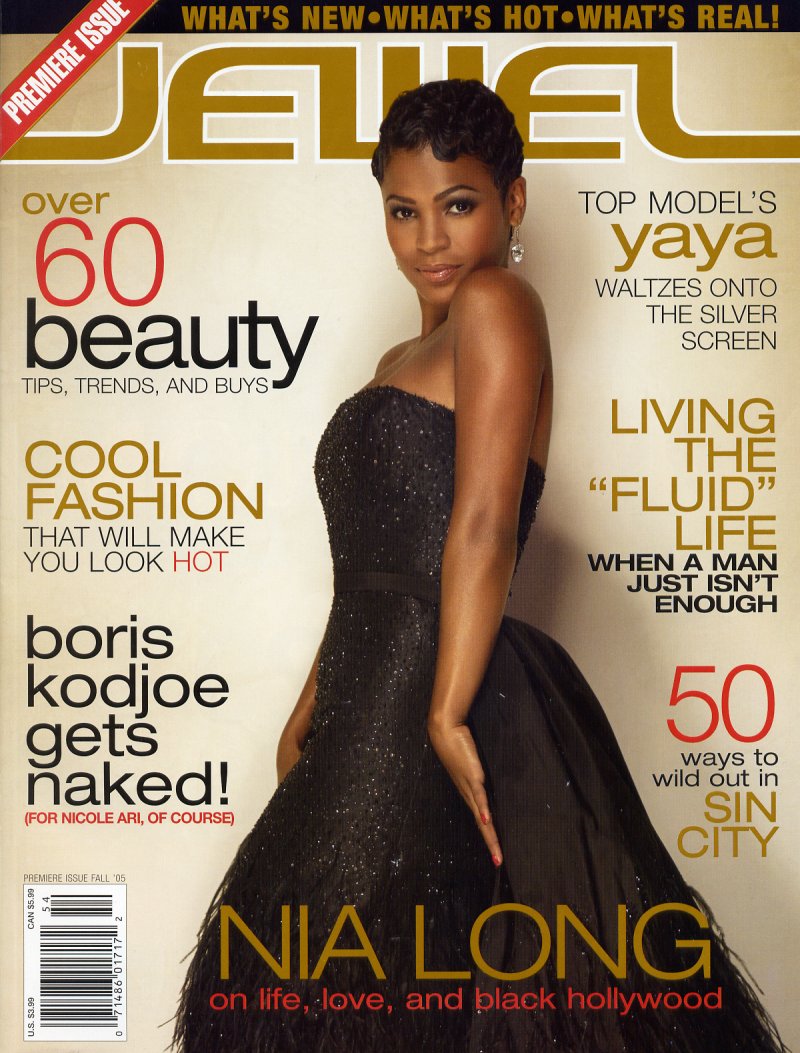
How Girl Power Helped Put a Black Man in the White House
Jewel Magazine (cover story) • Download or view the article (PDF).
by Justin Remus
Barack Obama is now the most powerful man in the world. But as the saying goes, “Behind every successful man, there’s a strong woman.” However, in Mr. Obama’s case, it would be women: Stanley Ann, his mother; Madelyn Dunham, his grandmother; and Michelle, his wife. All have been instrumental in molding his character and shaping his intrinsic beliefs. These three women not only inspired him, they also comforted him and sometimes even scolded him. They helped make him into who he is today: educator, author, activist, and politician. They’re the foundation of our first African-American president.
Stanley Ann Dunham
Obama’s mother Ann met his father Barack, Sr., who was from Kenya, while both were attending the University of Hawaii. Opposites attracted: she was a Kansas native; he was the school’s first-ever African student. They married when she was only 18—and three months pregnant—but two years later, Barack, Sr. left for Harvard to get his master’s degree in economics. Since he was a scholarship student, he could not afford to bring his family with him. Time and distance took its toll on their relationship, and he moved back to Kenya after graduation, leaving Ann to take care of their son on her own. Barack, Jr. saw his father just one more time (at age 10) before he died in an auto accident in 1982. Hard times forced Ann to turn to food stamps and the support of her parents. Although she faced all of the challenges of a single mother, she was never bitter and never tried to turn her son against his absent father. When Obama was six, Ann married an Indonesian schoolmate named Lolo Soetoro. The family later moved to Jakarta, Indonesia.
While living there, she would get up every day at 4:00 a.m. to give her son English lessons from a correspondence course. When he complained, she would say, “This is no picnic for me either, buster.” She also gave him recordings of Mahalia Jackson and Martin Luther King, Jr. so that he would have some connection to Black culture.
Four years later, Barack, Jr. (then known as “Barry”) was shuttled back to Honolulu to live with his grandparents in a small apartment (the same one his grandmother lived in until her recent passing). His mother—always doing what was best for her gifted son—wanted him to attend Punahou School, a prestigious preparatory school that had given him a partial scholarship.
“I think my mother was always searching for something. She wasn’t comfortable seeing her life confined to a certain box.”
A year later, she grew homesick and separated from her new husband, returning with their daughter Maya to the U.S. He wanted more children, but she wanted to go back to school. She had also grown tired of his Americanized lifestyle, which included employee get-togethers where the men would discuss golf scores, something Ann had learned to dread. Ann remained on good terms with Lolo, just as she had with Barack, Sr. She spent the next several years reunited with her son in Honolulu while pursuing her graduate degree at the University of Hawaii.
From this short timeline, we can see that Ann Dunham was a headstrong woman and a devoted mother. But who was she as a person? Like most of us, she was a complex individual with her own set of contradictions. She was a dreamer and a romantic who could also be pragmatic; a feminist who didn’t consider herself one; a teenage mother who later got a Ph.D. in anthropology; a white woman from Kansas who eventually felt most at home in Indonesia; a single mother of two who threw herself into her career; and a deeply spiritual person who shunned organized religion.
She was named Stanley Ann because her parents had wanted a boy. Her father’s name was Stanley, and she dutifully let others call her by that name until college, when she preferred to be called Ann.
While in high school, she learned to question authority and be skeptical of societal norms. The lessons stuck. One of her classmates says, “[Ann] was intellectually way more mature than we were and a little bit ahead of her time.” Another friend adds, “If you were concerned about something going on in the world, Stanley would know about it first. We were liberals before we knew what liberals were.” Maxine Box, another friend, says, “She was always challenging and arguing and comparing. She was already thinking about things that the rest of us hadn’t.” Another acquaintance referred to her as the “original feminist.”
Ann, who was a descendant of Jefferson Davis (the only president of the Confederacy), seemed most in her element in Indonesia, her adopted home. When she returned there to do her Ph.D. fieldwork in 1988, she studied Javanese handicrafts, such as batik and ironwork, and paid close attention to the local underground economy. She also learned how to weave, which she thoroughly enjoyed.
In 1992, after many years of study and fieldwork, Ann got her Ph.D. in anthropology at the University of Hawaii. Her 800-page thesis was on Indonesian blacksmithing. She then focused on rural development projects in Indonesia. An idealist through and through, she was committed to helping the economically disadvantaged, especially women. Her most significant achievement perhaps was helping to obtain microfinancing—i.e., small loans—for local craftspeople and other credit-poor entrepreneurs. Although microbanking is fairly common now, it was not back then. Ann’s anthropological research on working people directly influenced the policies of the Bank Rakyat Indonesia, one of the country’s largest banking institutions.
Obama referred to his mother during an interview as “the dominant figure in my formative years… The values she taught me continue to be my touchstone when it comes to how I go about the world of politics.” In his memoir, Dreams from My Father, he wrote, “What is best in me I owe to her.” Obama’s half-sister, Maya, says that he was protective of their mother while growing up. Although Ann was tough in her own way, she was also sensitive and could easily cry if she saw animals mistreated or if she felt misunderstood during a conversation. On the other hand, she would get on the back of a motorcycle and go out to do research in the field, where she exercised tremendous discipline.
Despite their frequent intervals of separation, Ann and her son shared a strong bond that lasted until her death. According to U.S. Representative Neil Abercrombie, a Hawaii Democrat who went to school with Ann and Barack, Sr., Ann’s influence on her son runs “very, very deep. [Obama’s] eclectic views of the world are a direct reflection of his mother.”
In fact, Obama shares many of his mother’s attributes. Like her, he believes that one can make the world a better place. He goes against convention and will take on multiple challenges. He has the courage to stand by his convictions. He has empathy for the less fortunate, and he has the ability to embrace the unknown.
Obama also learned from his mother how to make a powerful argument without being rigidly ideological. Ann went out of her way to foster activism and concern for the poor in her son, even when he was far more interested in basketball than social issues. His innate ability to connect with different types of people is directly related to her natural affinity with other cultures.
“When I think about my mother,” Obama told Amanda Ripley of Time, “I think that there was a certain combination of being very grounded in who she was, what she believed in. But there was also a certain recklessness. I think she was always searching for something. She wasn’t comfortable seeing her life confined to a certain box.”
Madelyn Lee Payne Dunham
Obama has said the biggest mistake in his life was not being at his mother’s side when she died of ovarian cancer in 1995. He made sure not to make the same error when his grandmother was on her deathbed right before the general election.
Obama called her Toot (short for “Tutu,” the Hawaiian word for “grandparent”) and, according to him, she was just as big an influence on his early life as his mother was. In Dreams from My Father, Obama refers to her as “quiet yet firm” and considered her to be ahead of her time because of her career accomplishments.
“I think there’s nobody more important than her, except his mother, in shaping his character,” says David Mendell, who interviewed Madelyn for the Chicago Tribune in 2004. He says that Obama obtained “that dreamer quality” in his speeches from his mother, but when deciding whom he should trust in the rough-and-tumble world of politics, “his grandmother’s practicality comes out. She was a real no-frills woman who was far more skeptical of human nature than his mother. And in politics, he has to rely on both of those characteristics.”
Madelyn and her husband Stanley were less than thrilled when Ann married Barack Sr., never more so when the latter’s father sent them a letter saying he didn’t want “the Obama blood sullied by a white woman.” But they managed to adapt, and when Ann became pregnant with Barack, Jr., Madelyn took a job as a secretary at the Bank of Hawaii to help provide for the baby. For over 20 years, she’d get up at 5:00 a.m., put on her formal clothes, and arrive at the office before any of her co-workers. She eventually became one of Hawaii’s first female bank vice presidents, a position that enabled her to earn more money than her husband. This later became a common topic of argument in their household. Colleagues remember her as a tough boss who would put her employees on the spot and test their capabilities, but they also recall her as someone who was sympathetic to those who worked hard.
“My grandmother was one of those quiet heroes that we have all across America. All they try to do is just do the right thing.”
At heart, Madelyn was a simple person with basic small-town Midwestern values and a sharp sense of humor. Her parents were very strict Methodists who forbade drinking, dancing, and gambling. During World War II, while her husband was overseas, Madelyn worked on a Boeing B-29 assembly line in Wichita, Kansas. One of her passions was playing bridge, and she was good at it, often playing six or even seven days a week after her retirement. She also enjoyed jigsaw puzzles, mystery novels, and going on cruises.
When Obama moved back to Honolulu from Indonesia at the age of 10, Madelyn became his surrogate mother, and she emphasized the importance of hard work and education, always making sure to set a good example. When her grandson needed money for his tuition, she would forego new clothes or a new car. She was thrifty, down-to-earth, and practical with a no-nonsense personality that contrasted with her daughter’s more starry-eyed one. Instinctively moderate, she taught her grandson to be patient, but to act decisively when it was required. During Obama’s acceptance speech at the Democratic convention in Denver, he said, “She poured everything she had into me.”
Like Ann, Madelyn was unusually tolerant of people’s differences. One time, Obama questioned her open-minded attitude towards racism. “Your grandfather and I just figured we should treat people decently. That’s all,” she replied. When Obama was running for the U.S. Senate and visited rural downstate Illinois, he was convinced that he connected with the voters there because of the Midwestern values instilled in him. “I know these people,” he told The New Yorker. “The food they serve is the food my grandparents served when I was growing up. Their manners, their sensibility, their sense of right and wrong—it’s all totally familiar to me.”
When Obama secured the Democratic nomination, Madelyn called him and said, “That’s nice, Barry. That’s nice.” It was her plainspoken way of giving her blessing to his historic achievement. During this past year, Madelyn, who suffered from osteoporosis, had undergone both corneal transplant and hip replacement surgeries, in addition to her ongoing battle with cancer. She rarely left her home, but she was kept up to date on her grandson’s campaign by watching CNN every day. In an interview with CBS News, Obama referred to his grandmother as “the rock of the family, the foundation. Whatever strength and discipline that I have, it comes from her.”
A week and a half before the election, Obama took the unprecedented step of suspending his campaign (unlike McCain’s phony suspension to “dedicate” himself to the bailout) to visit Madelyn at her bedside because she was gravely ill. In his final campaign appearance, Obama movingly recounted their final moments together. With tears streaming down his face, he said, “She was one of those quiet heroes that we have all across America. They’re not famous. Their names are not in the newspapers, but each and every day, they work hard. They aren’t seeking the limelight. All they try to do is just do the right thing.”
Tragically, Madelyn Dunham would lose her fight with cancer on the eve of the election at the age of 86. She didn’t live to see her grandson elected President of the United States, but during his victory speech in Chicago, Obama said, “I know my grandmother is watching, along with the family who made me who I am. I miss them tonight and know that my debt to them is beyond measure.”
Michelle Obama
Barack Obama found in his wife a quality that was lacking in his mother: stability. Unlike globetrotting Ann, Michelle has spent the last 10 years hanging out on Saturdays at a local pizza spot with the same two friends and all of their kids. She’s the backbone of the Obama family unit.
A dedicated mother and spouse, she always has her family’s best interests at heart. She insisted that Obama give up smoking before she would offer her support for his campaign. On the election trail, she bought MacBooks for her daughters and her husband so they could communicate via cyberspace. She also made sure she did not stay away from her daughters for extended periods of time. During an appearance on The Tonight Show, Michelle said, “When people ask me how I’m doing, I say, ‘I’m only as good as my most sad child.’”
Michelle can be lucid, engaged, poised, and passionate—all at the same time. She has a cool demeanor and is fiercely intelligent. She has juggled many roles throughout her life: mother, daughter, wife, sister, lawyer, community organizer, and hospital executive. Despite her career achievements, she is unpretentious and down-to-earth, with a vocabulary that includes phrases such as “freaky,” “24/7,” and “got my back,” and she doesn’t try to hide her love of macaroni and cheese, Stevie Wonder, and The Dick Van Dyke Show. She has also become a fashion icon of sorts by combining expensive designer clothes and off-the-rack styles from stores like The Gap. The media has often commented on her impeccable, understated style and taste, with more than a few making a comparison to Jackie Kennedy. Last summer, Vanity Fair included her on their “International Best Dressed List” for the second time, and she also made People’s 2008 list of 10 best-dressed women.
“Here’s to my husband, the man I love and I believe would be the best president.”
Like her husband, Michelle is a force to be reckoned with. A magna cum laude graduate of Princeton University and Harvard Law School, she is an accomplished attorney and was actually her husband’s boss at the law firm of Sidley & Austin, where her colleagues kept telling her about the cute summer associate who had been hired. According to her brother, Michelle resisted Obama’s advances at first, feeling that dating a co-worker was “tacky.”After she succumbed to his charms, she told her future husband, “I figured that they were just impressed with any black man with a suit and a job.”
Barack and Michelle have always shared a common desire to work for the collective good. Michelle gave up a lucrative career in corporate law to work in public service. Barack could have worked on Wall Street once out of Harvard Law School, but instead, he resumed being a community organizer while teaching constitutional law at the University of Chicago. Michelle became vice president for community and external affairs at the University of Chicago Hospitals.
Like the Clintons, the Obamas are a formidable power couple. Since the very beginning of their relationship, it’s been as if they were preparing for their future life in the White House. Along the way, they have shared organizational connections, advisors, and issues they both feel strongly about.
“Michelle is serious when it comes to being a mom. That’s why our girls are so wonderful. She is the one who deserves most of the credit.”
It’s been an extremely effective partnership that has elevated two very ambitious people much higher than either would have gone on their own. Obama eased Michelle into the world of community organizing, where she ended up working for some of his colleagues. In return, she introduced him to prominent black businessmen, politicians, and civic leaders, who paved the way for his political ascension. The Obamas have been well-known fixtures among the philanthropic crowd in Chicago for quite some time, a testament to their success.
During the 2008 campaign, Michelle refused to sit in on her husband’s political meetings with his advisors and offer suggestions, but she did stump for him effectively, composing a 45-minute speech that she wrote herself and delivered confidently without notes. Obama’s strategists initially saw her as a loose cannon, but they later amended their opinions as she became a disciplined advocate for his campaign. She drew large crowds and didn’t make any huge blunders as she emphasized her family story as a substitute for her husband’s, reassuring voters who raised questions about his time spent outside of America as a youth.
In contrast to her husband’s lofty rhetoric, Michelle’s speeches were more grounded, but equally passionate. There were some movingly tender moments, such as when she got emotional while giving a speech to friends on the evening of the Iowa caucuses. “Here’s to my husband, the man I love and the man I believe would be the best president,” she said, choking back tears.
There was a time, however, when Michelle vehemently opposed her husband entering politics altogether. She was not fond of his prolonged absences and expressed her displeasure to him when he joined the presidential race. Never one to mince words, her critics have attacked her for being too honest in the public sphere, particularly the time during a campaign stop in Milwaukee in February of 2008 when she said, “For the first time in my life, I am proud of my country.” To put it in context, Michelle was actually saying that she was proud of her country because “hope was making a comeback.” Either way, the damage was done. The right-wing media savagely attacked her for her supposedly “anti-American” remarks. Other pundits portrayed her as a harpy who pointed out that her husband had body odor and bad breath, as well as sharing other unseemly details of their domestic relationship.
But there was a strategy at work here. The Obamas wanted to prove to Americans that they were just like the rest of us. Barack made himself out to be the typical hapless husband, writing that he was too “domesticated and soft” to remember to buy a shower curtain when he was a freshman senator on his own in Washington, D.C., Michelle told reporters how she encouraged him to read to his daughters during the rigors of the presidential campaign, emphasizing that they were a tight, loving family. If the results of the election are any indication, their approach worked like a charm.
Michelle is certainly not afraid to poke fun at their marriage. Much laughter ensued on her Tonight Show appearance when she said that Obama prepared for his debates by spending time with her. The couple also loves retelling the anecdote about his speech at the 2004 Democratic convention. Just before he took the stage, Michelle pulled him to the side and said, “Just don’t screw it up, buddy!”
“Our hope is that the White House will feel open and fun and full of life and energy. The primary focus for the first year will be making sure that the kids make it through the transition.”
The tale may be embellished, given that others have seen a gentler dynamic at play between the couple. In a piece about Michelle by Lauren Collins in The New Yorker, an observer saw firsthand the preparation of that same speech when Obama was getting antsy with all the last-minute tweaking. Michelle was present, and the witness recalls how “she was listening intently and, without being overly directive, was somebody that he could glance over to. It was almost a telepathic kind of relationship. He was clearly looking to her for reaction.”
Of course, a lot has changed since 2004. The dream is now a reality: Barack Obama is the 44th President of the United States of America. When interviewed by 60 Minutes immediately after the election about what life will be like for the Obama family come January, he said, “We are as close to what normal folks go through as just about anybody who’s been elected president. Michelle helps with that because she’s a sensible person.” He later added, “Here’s one thing I know about Michelle: She’s serious when she talks about being a mom. That’s why our girls are so wonderful. I’d love to take credit for it, but she is the one who deserves most of the credit.”
Whether she likes it or not, Michelle will be a living example for all career women who are juggling job responsibilities and raising kids. She has made it clear that she has no plans to play an important role in influencing her husband’s leadership. It’s not likely that Michelle will completely redesign the White House’s interior, either. Those close to her say she has only a limited interest in the domestic arts, choosing instead to get things done efficiently and with a minimum of hassle.
In the 60 Minutes interview, she shared what was going through her mind when Laura Bush was showing her around the White House: “I couldn’t help but envision the girls running into their rooms and, you know, running down the hall with a dog. And you start picturing your life there. And our hope is that the White House will feel open and fun and full of life and energy… The primary focus for the first year will be making sure that the kids make it through the transition. But there are many issues I care deeply about. I care about military families and the work/family balance issue. I care about education… There’s plenty to do.”
Along with the usual dignitaries who will visit the White House, there will likely be sleepovers with Malia’s and Sasha’s friends, groups of young girls in their sleeping bags. Although the Obamas will surely miss their home and friends in Chicago, they’re looking forward to being able to have dinner together for the next four years.
As Melissa Harris-Lacewell, associate professor of politics and African-American studies at Princeton University, told Democracy Now’s Amy Goodman, “Part of what I think is exciting about the Obamas moving into the White House is that there’s a family moving in. There are two African-American girls, little girl children, who are going to grow up with 1600 Pennsylvania Avenue as their home address. That’s an astonishing difference for our country.”
Copyright Star Media, 2008.